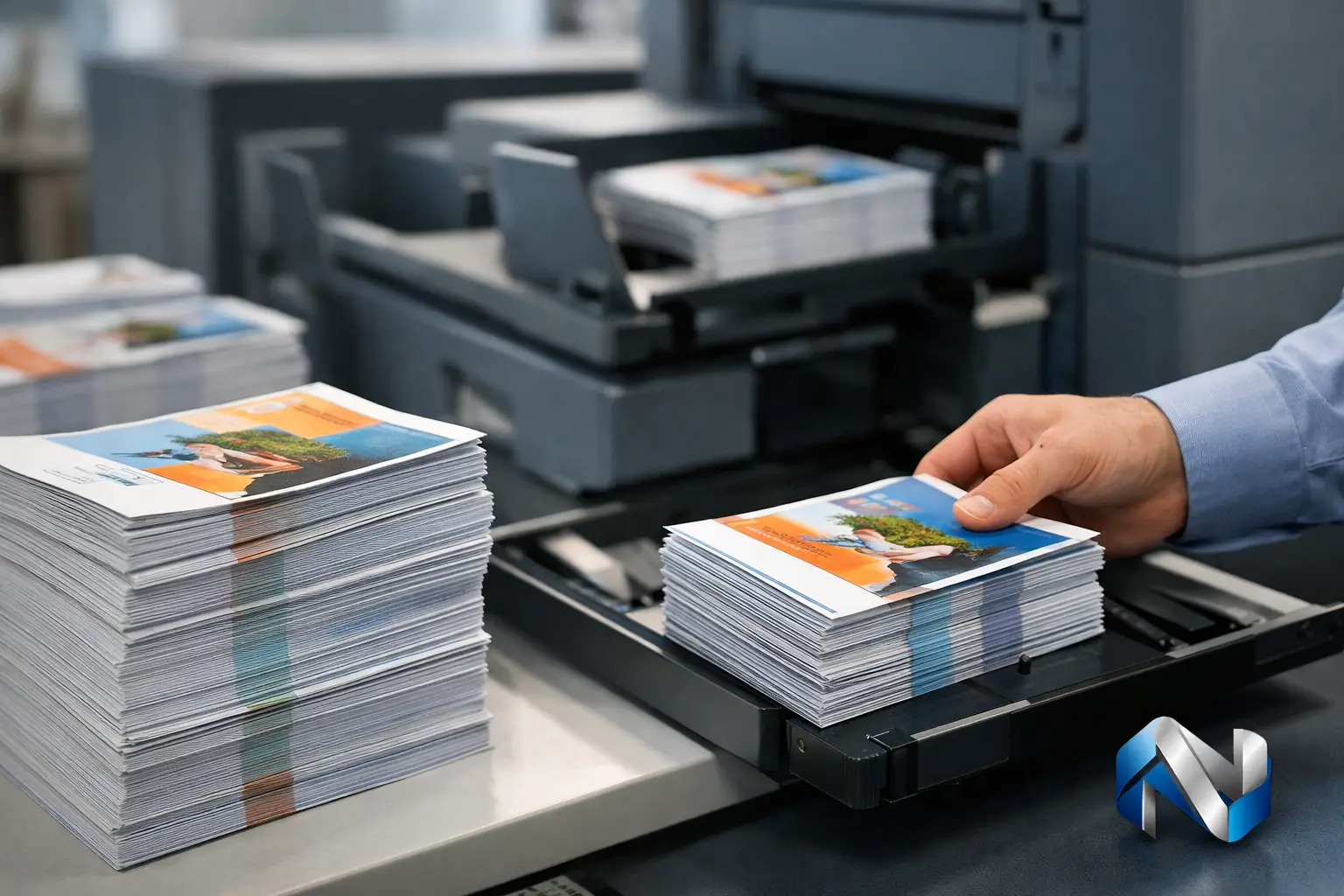
A stack of flyers can either sit on a counter or bring people through the door. The difference usually comes down to planning. Bulk flyer printing is not just about getting a lower unit price. It is about ordering the right quantity, building a design that gets noticed quickly, and choosing print specs that match how the piece will actually be used.
For local businesses, schools, event organizers, and community groups, flyers still do a job that digital ads often cannot. They are physical, immediate, and easy to hand out, post, insert, or leave behind. When the timing is right and the message is clear, a flyer becomes one of the most practical tools in your marketing mix.
Why bulk flyer printing still makes sense
Flyers work because they are simple. They put one message in front of one person without asking for a click, a login, or a screen. That matters for grand openings, seasonal promotions, fundraisers, community events, menu drops, service reminders, and limited-time offers.
Printing in larger quantities also changes the economics. If you know you will need repeat handouts over a campaign period, bulk ordering usually lowers your cost per piece and reduces the stop-and-start cycle of placing small orders. It also helps with consistency. Your team is working from the same message, same branding, and same print quality across the entire run.
That said, bigger is not always better. If your pricing, dates, or offers change often, ordering too many can create waste. A good print run is not the biggest one possible. It is the one that fits your timing, distribution plan, and shelf life.
When a large flyer order is the smart move
Some projects are made for volume. If you are promoting a city-wide event, running a political campaign, introducing a new neighborhood service, or stocking multiple business locations, a larger order makes sense. The same applies when several departments or campuses need the same core piece.
Bulk flyer printing is also useful when your business has recurring outreach. Restaurants, trades, real estate offices, fitness studios, and nonprofits often need steady quantities over time. In those cases, ordering more upfront can save money and keep materials ready when your team needs them.
The trade-off is flexibility. If your content is likely to change next month, you may be better off printing a moderate amount now and reordering later. A dependable print partner can help you balance price against the risk of outdated material.
Getting the format right from the start
Flyers are straightforward, but format still matters. Size affects visibility, handling, and mailing cost. An 8.5 x 11 flyer gives you room for more detail, while a smaller handbill is easier to distribute at events or package with other materials.
Paper choice matters just as much. A heavier stock feels more substantial and holds up better in high-traffic settings. A lighter stock may be the better choice for mass distribution, inserts, or short-term promotions where budget and volume are the priority. Gloss can make colors pop, but uncoated stock is often easier to write on and can feel more approachable for forms, coupons, or response-based campaigns.
There is no single best option. A restaurant promotion, school notice, and retail sale flyer all have different needs. Good print planning starts with asking how the flyer will be held, posted, handed out, or mailed.
Designing bulk flyer printing for real-world attention
A flyer has only a few seconds to do its job. Most people will glance before they decide whether to read. That means the design needs to communicate fast.
Start with one clear message. If the flyer is promoting an event, the event name, date, time, and location should be obvious immediately. If it is advertising a service, the main benefit should be visible before the person reads the body copy. Trying to fit every detail onto the page usually weakens the piece.
Strong hierarchy makes a difference. Use a headline that earns attention, a subhead or short supporting line that explains the offer, and a clear call to action. White space is not wasted space. It helps the important parts stand out.
Images should support the message, not just decorate the page. A sharp product photo, a relevant event image, or recognizable branding can improve response. Low-resolution images and crowded layouts tend to do the opposite. In print, quality shows.
Common mistakes that weaken flyer results
The most common problem is saying too much. Businesses often treat a flyer like a brochure and try to include every service, every testimonial, and every detail. A flyer works better when it stays focused.
Another issue is weak production planning. Tiny text, poor contrast, and artwork built for screen rather than print can all hurt readability. So can choosing paper or finishes without thinking about use. A glossy flyer posted under bright lights may be harder to read. A thin sheet handed out outdoors may not hold up well.
There is also the issue of quantity guessing. Ordering too few can interrupt a campaign. Ordering too many can leave you with boxes of outdated pieces. This is where experience matters. A local print shop that handles commercial work every day can often spot mismatches before they become expensive.
How to plan quantity without overordering
Quantity planning should start with distribution, not budget alone. Ask how the flyers will be used, where they will go, who will hand them out, and how long the message will stay relevant. If you have five locations, a weekend event, and a two-month promotion, estimate each channel separately rather than choosing a round number.
It also helps to build in a small buffer. Staff use extras. Displays need refilling. Last-minute opportunities come up. But a buffer should still be sensible. If your pricing changes every quarter, printing a year’s worth of promotional flyers may not be the smartest move.
For many organizations, the right answer is a balanced run size with room to reorder quickly. That is often more practical than chasing the lowest possible unit cost.
Working with a local print partner on bulk flyer printing
When deadlines are tight, local service matters. A reliable print partner can review files, catch setup issues, recommend stock, and keep the project moving without unnecessary delays. That is especially valuable for businesses and organizations managing multiple materials at once, from flyers and posters to forms, signage, and branded items.
A local shop also understands practical distribution realities. In a market like Kamloops and the surrounding region, flyer use may vary widely between retail promotions, community events, school communications, and regional outreach. Advice based on real production experience is often more useful than generic online ordering.
This is where a full-service provider has an advantage. If your flyer campaign also needs matching posters, booklets, presentation folders, or variable data pieces, keeping those projects with one team saves time and improves consistency. Noran Printing works that way – as a one-stop print shop built to support ongoing business needs, not just single transactions.
Timing, turnaround, and quality control
Bulk jobs need speed, but speed should not come at the expense of quality. Color consistency, clean finishing, and file accuracy all matter more when you are printing at volume. Minor issues become major ones when they repeat across thousands of pieces.
That is why prepress review, proofing, and production checks are worth taking seriously. A good turnaround is not just fast. It is dependable. You want to know that the final pieces will match expectations and arrive ready to use.
If your campaign has a fixed launch date, order early enough to allow for review and any needed adjustments. Rushed projects can still be done well, but more lead time gives you more control.
Making flyers part of a bigger print strategy
Flyers are strongest when they support a broader effort. A handout at an event can match your posters in town. A promotional flyer can reinforce signage at the point of sale. A leave-behind piece can complement business cards, brochures, or branded forms your team already uses.
That consistency builds recognition. It also makes your print budget work harder. Instead of treating every item as a separate task, you create a coordinated set of materials that support the same message.
Bulk flyer printing works best when it is treated as a business tool, not just a quick order. Get the quantity right, keep the message focused, and choose specifications that fit the job. A well-printed flyer may be simple, but simple done well still gets results.