When an invoice book is poorly designed, the problem shows up fast. Staff write around cramped boxes, duplicate copies become hard to read, and small mistakes turn into billing delays. Custom invoice books printing solves that by giving your team forms that match how your business actually works, not a generic pad that almost fits.
For many businesses, invoice books are still part of daily operations. Field service companies, trades, delivery teams, repair shops, nonprofits, schools, and local organizations often need a reliable paper record on the spot. Even when accounting software handles final reporting, a printed invoice book can keep jobs moving in the field, capture signatures, document materials used, and provide a copy to the customer right away.
Why custom invoice books printing still matters
Printed invoices are practical. They do not depend on a charged device, a stable connection, or employees working around a screen in a truck, warehouse, job site, or front counter. They are also easy to file, simple to hand to a customer, and familiar for teams that need a straightforward process.
That does not mean every business needs the same setup. A contractor may want room for labor hours, materials, and site notes. A service business may need a customer signature line and a checkbox for follow-up work. A school department or community organization may want internal approval fields before billing is finalized. This is where custom printing becomes useful. The form reflects your workflow instead of forcing your workflow to fit the form.
There is also a branding benefit. A clean, well-printed invoice book with your business name, logo, phone number, and payment terms presents your company as organized and dependable. That matters more than many people realize. Invoices are not just records. They are customer-facing documents that reinforce professionalism.
What to include in a custom invoice book
The best invoice books are built around the information your team needs to capture accurately and quickly. In most cases, that starts with the basics: company name, contact details, invoice number, date, customer information, description of goods or services, pricing, taxes, and total due.
From there, the right layout depends on your operation. Some businesses need purchase order fields. Others need space for equipment details, service addresses, technician names, or delivery instructions. If your team regularly writes the same extra notes by hand, that is usually a sign those fields should be built into the form.
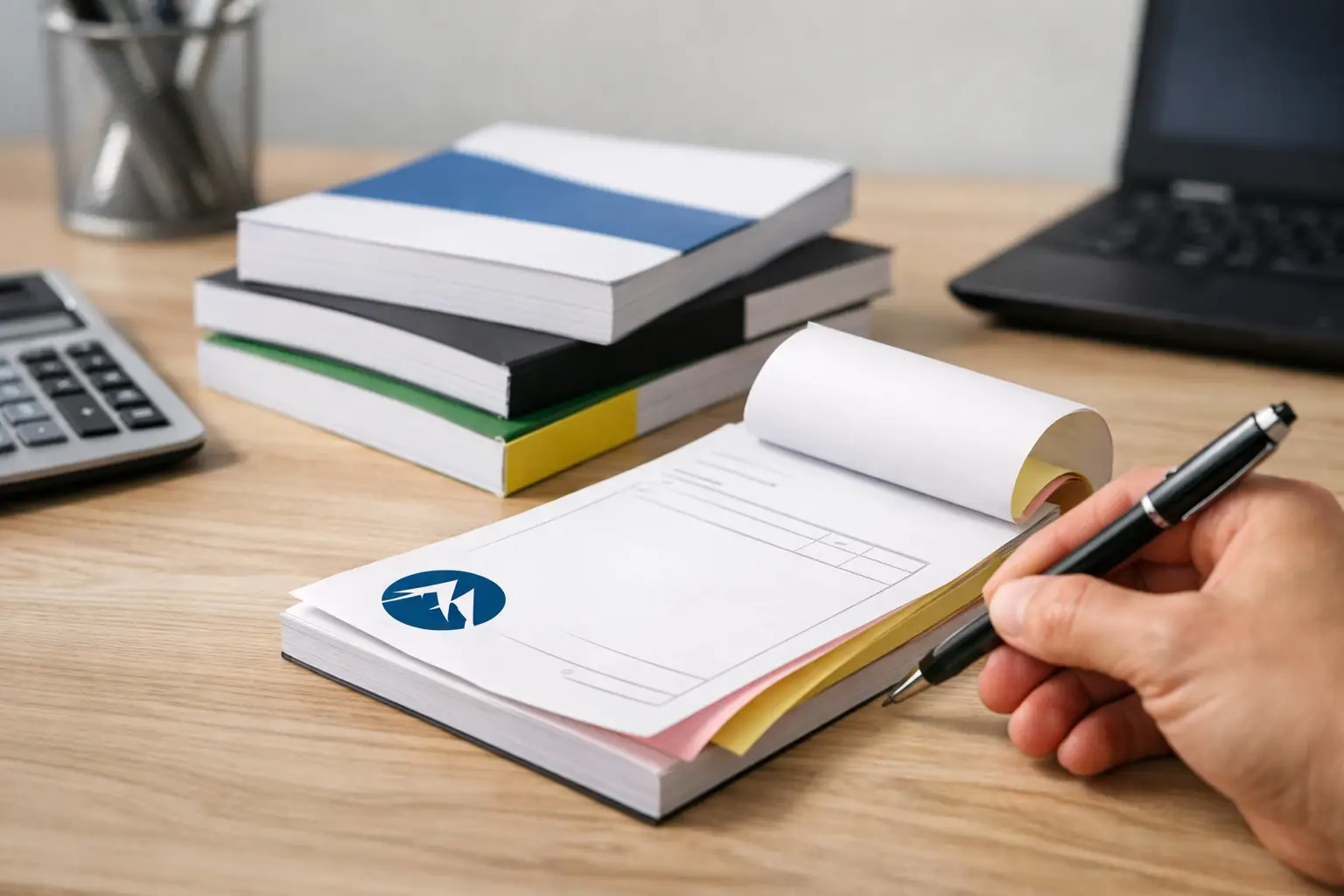
A carbonless multi-part layout is often the practical choice. One copy goes to the customer, one stays with the office, and one remains in the book for internal records. Sequential numbering is another feature that makes a real difference. It helps with tracking, filing, and reducing duplication or skipped records.
If you process payments in the field, it may also make sense to include payment method checkboxes, deposit lines, or balance due sections. Small design decisions like these save time over hundreds of transactions.
Getting the layout right
A good-looking form is not always a good working form. In custom invoice books printing, function should lead the design. That means enough writing space, logical field order, and clear section breaks so users can complete the form quickly.
Too much information squeezed into one page creates errors. Too little structure creates inconsistency. The goal is balance. Your staff should be able to complete the form in a way that is fast but still legible, especially if you are using duplicate or triplicate sets.
Typography matters here more than people expect. Simple fonts, clear labels, and strong contrast improve readability. So does thoughtful spacing. If your invoices are completed by hand in vehicles or on job sites, extra room is often worth more than decorative design elements.
Paper choice matters too. Carbonless paper needs to transfer cleanly from the top sheet to the copies below. If the stock is poor or the writing area is badly designed, the second and third copies can become difficult to read. That creates headaches for accounting and customer records.
Choosing the right format for your business
Invoice books are not one-size-fits-all. Some businesses do best with small portable books that fit in a truck or tool bag. Others need larger forms that allow more itemization and clearer recordkeeping in an office or retail setting.
Binding style also affects usability. A wraparound cover can help prevent writing from transferring to the next set. Perforation may be necessary if customer copies need to tear out neatly. Book size, number of sets per book, and number of parts per form should all be chosen based on how your team actually uses the forms.
This is one of those areas where ordering the cheapest option can cost more later. If the book is awkward to carry, hard to write in, or poorly matched to your process, the daily inconvenience adds up. A better setup usually pays for itself in faster paperwork and fewer avoidable errors.
Common mistakes businesses make
One common mistake is reordering an old form without reviewing whether it still fits the current workflow. Businesses change. Services expand, tax requirements shift, and payment processes evolve. If your staff has been crossing out labels or writing the same information in the margins, the form likely needs an update.
Another mistake is treating invoice books as a minor purchase instead of an operational tool. A form used every day should be planned with care. The cost difference between a generic book and a well-designed custom one is often small compared to the value of smoother billing and better documentation.
There is also the issue of brand consistency. If your invoices look disconnected from your business cards, letterhead, envelopes, and other printed materials, the customer experience can feel pieced together. For businesses that care about a professional presentation, matching printed materials creates a stronger overall impression.
Working with a local print partner
Custom forms are easier to get right when you can talk through the details with an experienced print provider. That matters when you are deciding on numbering, carbonless sets, paper colors, binding, size, and layout changes that affect usability.
A local print shop can also help you think through details that are easy to miss. Do you need duplicate or triplicate copies? Should customer copies be a different color from office copies? Do you need books split by department, team, or staff member? Should numbering continue across multiple books for cleaner recordkeeping?
For businesses in Kamloops and the surrounding area, that kind of hands-on guidance can save time and prevent expensive reprints. It also makes repeat ordering easier because your specs are already established and your print partner understands how your operation runs.
Noran Printing works with businesses and organizations that need practical print materials they can count on, and invoice books are a good example of where dependable production and clear communication matter.
How custom invoice books printing supports day-to-day operations
The real value of custom invoice books printing is not just appearance. It is consistency. When every team member uses the same layout, records become easier to read, process, and file. That helps with billing speed, internal accountability, and customer communication.
It can also reduce training friction. New employees do better when forms guide them through the required information in the correct order. Office staff benefit too because cleaner paperwork means fewer follow-up calls and fewer missing details.
For some businesses, paper invoices are a long-term system. For others, they are a field tool that supports a larger digital process. Either way, the best custom books are designed around real use, not assumptions. That may mean keeping the layout simple, or it may mean adding more structure to support a more detailed workflow. It depends on who uses the form, where they use it, and what needs to happen after it is filled out.
If your current invoice books create extra work, that is usually a sign they are not doing their job well enough. A better form will not fix every process issue, but it can remove daily friction your team has learned to tolerate. That is a worthwhile upgrade for any business that values accuracy, professionalism, and time well spent.