A restaurant changes its lunch feature at 10 a.m. A school needs to promote an event next week. A retailer has one message it wants every customer to see for the next three months. These are different communication jobs, and the best display solution is not always the same. When comparing digital signage vs printed posters, the practical question is simple: which option will get your message noticed, stay on budget, and be easy for your team to manage?
For many local businesses and organizations, print remains the most dependable choice for clear, long-lasting promotion. Digital displays can be highly effective when information changes frequently or needs to move with the time of day. The right decision comes down to the message, the location, the audience, and how often the content needs to change.
Digital Signage vs Printed Posters: The Main Difference
Printed posters are fixed physical displays. Once designed and printed, they deliver the same message every time someone sees them. They can be displayed in windows, on walls, at event entrances, on bulletin boards, in storefronts, or wherever people naturally pause and look.
Digital signage uses a screen to display still images, video, slides, menus, announcements, or rotating promotions. Content can be updated remotely or directly at the display, depending on the system. A single screen can carry many messages over the course of a day.
That distinction affects nearly every part of the decision. Posters have a lower entry cost, no technical learning curve for viewers, and no dependence on power or connectivity. Digital signage offers speed and flexibility, but it requires equipment, installation, content management, and ongoing attention.
Neither format is automatically more professional. A well-designed poster on quality stock can make a strong, credible impression. A poorly placed screen with outdated slides can do the opposite. The goal is to match the format to the job.
When Printed Posters Make More Sense
A poster is often the better investment when your message is stable. Think of a seasonal promotion, a fundraiser, a community event, a new product launch, a safety reminder, or a campaign with a defined date range. If the offer will not change every few days, printing a poster is straightforward, visible, and cost-effective.
Printed posters also work well in locations where people move through quickly. A clean headline, strong image, and clear call to action can be understood in seconds. In a retail window, reception area, hallway, or café, a poster does not compete with motion, transitions, or a crowded slide rotation. It simply presents the message.
For organizations with several locations, printed posters can provide reliable brand consistency. Every branch, office, classroom, or community board receives the same approved piece. There is no concern about a screen being turned off, a file failing to load, or an old message remaining in a playlist.
Print has practical advantages in outdoor and temporary settings as well. Event signage, election notices, construction communications, tournament promotions, and community announcements often need to be installed quickly in places without access to power. A properly produced poster can handle the assignment without adding technical requirements.
Print offers physical presence
There is also value in the physical nature of a poster. People can point to it, take a photo of it, or see it repeatedly in the same place. A poster can become part of the environment rather than another screen competing for attention.
Quality matters here. Paper choice, finish, size, color accuracy, and mounting all affect how the final piece performs. A small poster with too much copy can disappear in a busy area. A larger format with a focused message and readable type has a much better chance of earning attention.
When Digital Signage Is Worth the Investment
Digital signage is most useful when information changes often. A restaurant menu with daily specials, a clinic with wait-time notices, a fitness center with class updates, or a venue with changing schedules can benefit from the ability to update content without reprinting materials.
It is also effective when several messages need to share the same space. A screen in a hotel lobby might rotate through event details, local information, dining promotions, and service notices. A dealership can display current offers alongside vehicle features and financing reminders. Instead of choosing one poster, the business can schedule a sequence of messages.
Motion can help draw the eye, particularly in a high-traffic indoor environment. Short video clips, animated text, and timely images can add energy to a display. That said, movement should support the message, not distract from it. If viewers cannot understand the offer in a few seconds, the screen may be visually active but commercially weak.
Digital signage can also support time-sensitive communication. A display may show breakfast promotions in the morning, lunch offers at midday, and evening events later on. This makes it a strong fit for businesses with frequent changes and staff who can keep the content current.
Digital signage has ongoing responsibilities
The screen itself is only part of the investment. Businesses should account for hardware, mounting, electrical access, software or media players, installation, content creation, and maintenance. A low-cost display can become expensive if it requires repeated troubleshooting or is not suited to its environment.
Content management is equally important. Someone needs to update pricing, remove expired promotions, confirm that schedules are accurate, and review the display regularly. Digital signage performs best when there is a clear owner for the system. Without that responsibility, it can quickly show stale information that damages customer confidence.
Compare the Real Costs, Not Just the First Cost
Printed posters generally cost less to launch. You pay for design, printing, and any mounting or distribution needed. When the message changes, you print a new version. For short campaigns or occasional promotions, this is often the most efficient model.
Digital signage usually has a higher upfront cost because the business is purchasing or leasing equipment and setting up the system. Over time, it may reduce reprint costs if messages change frequently. But savings only materialize when the screen is used consistently and managed well.
Consider a retail shop that changes promotions monthly. Printed posters may be the sensible choice, especially if each campaign needs a polished seasonal look. Now consider a restaurant that changes menu items, prices, and specials several times a week. A digital menu board may justify its cost because staff can make updates quickly and avoid frequent reprints.
The most accurate budget comparison includes the value of staff time. If employees spend hours replacing paper signs, confirming pricing, or correcting last-minute changes, flexibility has a real value. On the other hand, if staff do not have time to manage a digital system, a professionally printed poster may be the more reliable option.
Visibility Depends on Placement and Design
A screen does not automatically get more attention than a poster. Location, lighting, viewing distance, and message design matter more than the format alone.
For either option, begin with the viewing situation. Is the audience walking past from 15 feet away? Standing in a line for two minutes? Sitting in a waiting room? Reading from a vehicle? The answer determines the right size, amount of text, image treatment, and call to action.
A poster intended for quick viewing should have one main idea. Use a bold headline, a strong visual hierarchy, and enough contrast to read clearly. Include contact details or a QR code only if they serve a clear purpose. Too many details reduce impact.
Digital displays need the same discipline. A slide should not look like a brochure placed on a screen. Use large type, simple layouts, and enough time for viewers to absorb the message. Keep transitions restrained. The strongest digital signage often communicates one message at a time, then repeats it often enough for people to catch it.
A Combined Approach Often Delivers Better Results
Many businesses do not need to choose one format exclusively. Printed posters and digital signage can support each other.
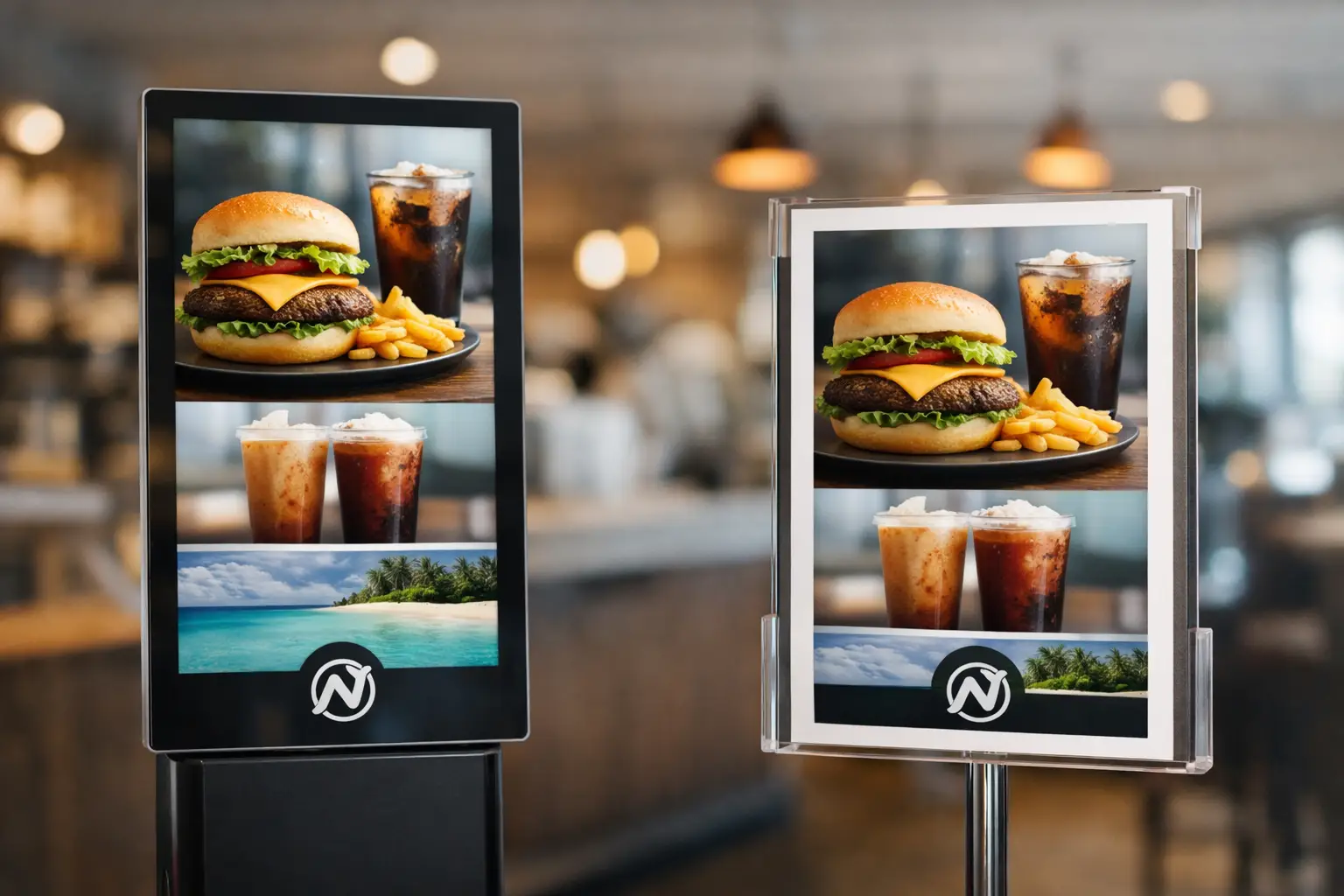
A digital screen can handle changing information, while posters reinforce a central campaign throughout the building. A school can use a screen for daily announcements and printed posters for major events, registration deadlines, and fundraising efforts. A restaurant can update menu boards digitally while using printed window posters to promote a seasonal feature to people outside.
This combined approach gives each format a role. Digital signage handles speed and rotation. Print provides lasting visibility, broad placement options, and a tangible brand presence. It also protects against the common issue of asking one screen to communicate everything.
How to Choose the Right Display for Your Business
Start by looking at how often the message changes. If it changes daily or weekly, digital signage deserves serious consideration. If it stays relevant for a month, season, or campaign period, posters are likely the simpler choice.
Next, consider where people will see it. A window, community board, event space, or location without power favors print. A lobby, checkout area, waiting room, or menu counter may be well suited to a screen. Then consider who will manage updates. A display strategy only works when the content remains accurate and on brand.
For Kamloops-area businesses, schools, and community organizations, a local print partner can also help determine practical details such as poster size, stock, finishing, and quantities. Noran Printing can produce professional posters and branded display materials with the same attention to color accuracy and consistency that your organization brings to its customer experience.
Choose the format that makes your message easiest to see, easiest to trust, and easiest for your team to keep current. A display does not need to be flashy to work well. It needs to be clear, well made, and placed where your audience is ready to notice it.