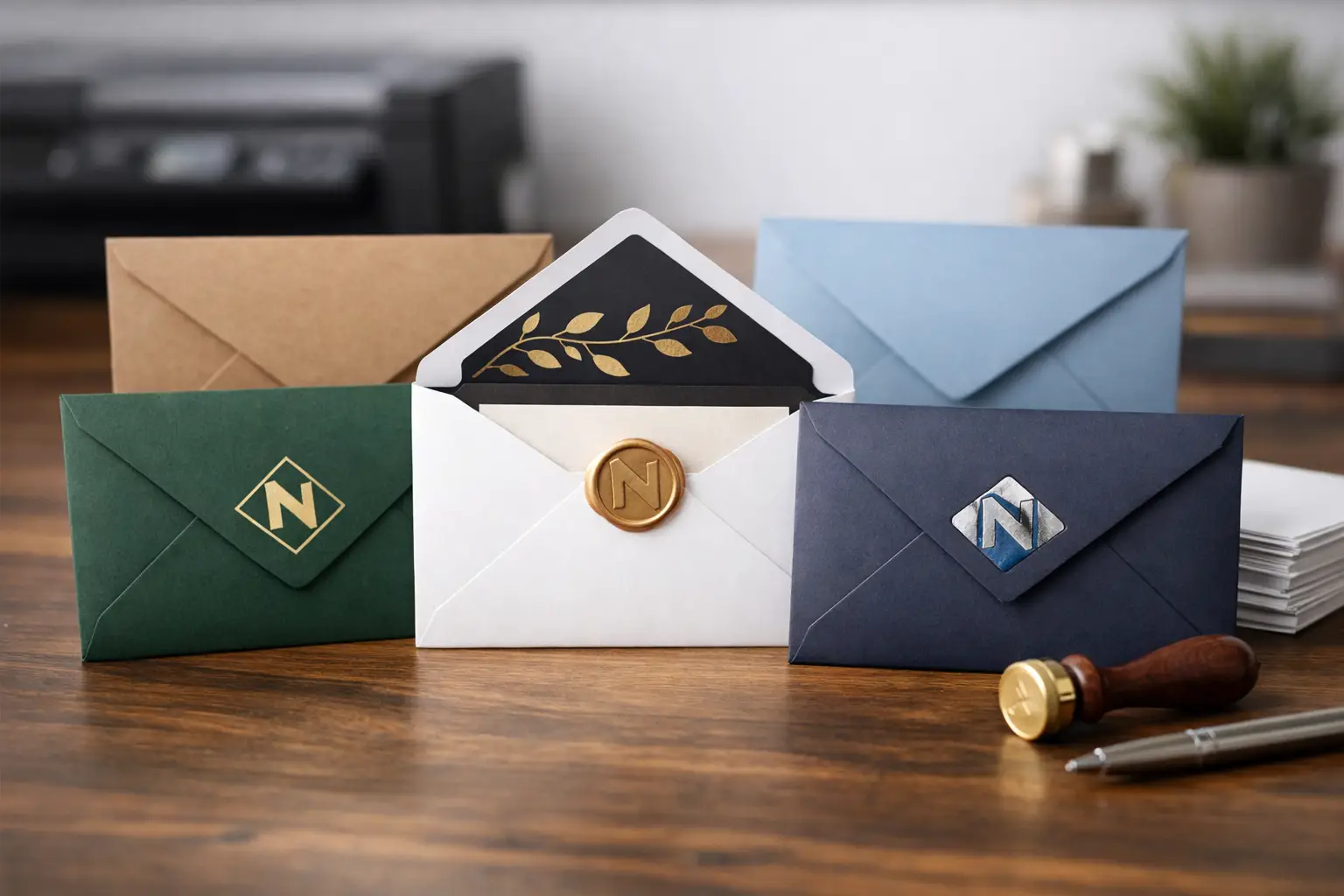
The envelope gets seen before the letter inside, which makes it one of the hardest-working pieces in your print package. A smart guide to custom envelope printing starts there – not with decoration, but with function. If your envelopes look sharp, print cleanly, and move through the mail without trouble, they do more than carry paper. They reinforce credibility.
For many businesses, envelopes are treated like an afterthought until something goes wrong. The logo shifts too close to the edge, the tint interferes with postal marks, the flap style does not suit the insert, or the return address prints inconsistently across a large run. Those details matter, especially for organizations that send invoices, statements, appointment reminders, direct mail pieces, contracts, or formal correspondence on a regular basis.
Why custom envelopes still matter
Email handles speed, but printed mail still carries weight. A branded envelope signals that the contents are official, intentional, and worth opening. That matters for schools sending notices home, nonprofits running campaigns, medical offices mailing statements, and businesses following up with clients.
Custom envelope printing also supports consistency across your printed materials. If your business cards, letterheads, invoices, and presentation folders all carry the same visual identity, a plain stock envelope can break that chain. A custom envelope completes it.
There is also a practical side. Preprinted return addresses, department identifiers, remittance instructions, or reply mailing details save time at the office. Over hundreds or thousands of pieces, that efficiency adds up.
Start with the job the envelope needs to do
The best envelope is not always the fanciest one. It is the one that fits the contents, holds up in handling, and presents your brand clearly.
A standard #10 envelope is still the most common choice for business correspondence because it fits a tri-fold letter and works well for invoices, statements, and everyday mail. If you are sending checks, remittance forms, or documents that should not be folded, a larger format may make more sense. Announcement-style envelopes work well for invitations, event mailers, and cards, while window envelopes can save time when you want the recipient address pulled directly from the printed insert.
This is where many buyers make a costly mistake. They choose based on appearance first, then try to force the contents to fit. That can create bulging, wrinkling, or folding issues that make the mailpiece look careless. In some cases, it can even affect postage or machine processing.
Common envelope choices for business use
A #10 envelope is the reliable default for letters and invoices. A 9 x 12 envelope works better for booklets, contracts, and flat documents. Window envelopes are useful when your mailing process is built around statements or forms. Remittance envelopes are often used by charities, service providers, and organizations collecting payments or responses.
The right format depends on what you send most often, how often you send it, and whether speed in preparation matters more than flexibility.
Design for print, not just for screen
A good-looking digital file does not always become a good-looking envelope. Envelope printing has its own limits, especially around margins, flap placement, seams, and the non-printable areas created by certain presses or converting equipment.
Your logo and return address should sit in a position that stays readable and balanced without interfering with postage, barcodes, or postal endorsements. If the design extends too close to the top right corner or too low on the face, it can create issues once the piece enters the mail stream.
Color choice matters too. Dark backgrounds and heavy coverage can look impressive, but they are not always the best fit for mailing. Some postal systems require clear contrast for addressing and processing. If you plan to add addresses later with a laser printer or inkjet, the stock and ink coverage need to support that method. Gloss, texture, and deep flood colors can complicate overprinting.
What to include on a custom envelope
Most business envelopes need only a few elements: logo, return address, and sometimes a department line, tagline, or subtle brand color. More is not always better. Crowded envelope designs tend to feel less professional and can compete with the mail handling information.
If you send mail from multiple departments, consider versioning the envelope rather than forcing one design to serve every use. This is where variable data printing or short-run digital production can help. It gives you more control without requiring oversized inventory of one generic envelope.
Paper stock affects more than appearance
Envelope paper has to do two jobs at once. It needs to represent your brand well and perform properly in handling, insertion, addressing, and mailing.
A bright white wove stock gives a clean, professional look and works for most business applications. It prints crisply and keeps logos and text sharp. Tinted stocks can add personality, but they should be used carefully, especially for formal business mail or anything that needs machine readability. Heavily textured papers may look premium, but they are not always ideal if you plan to overprint addresses or send high volumes through inserters.
Opacity matters when privacy matters. If the contents should not show through the envelope, the stock needs enough body and coverage to prevent shadowing. Security tints on the inside are a practical choice for financial documents, statements, or sensitive correspondence.
There is always a trade-off. Premium paper can improve presentation, but if the envelope is used for routine operational mail, a simpler stock may give you a better balance of cost and performance.
Printing method and run size
The quantity you need should shape the production method. Large runs of a standard design often make sense through conventional production because unit costs drop as volume rises. Shorter runs, seasonal campaigns, or envelopes that change by department or location often benefit from digital printing.
This matters for businesses that do not want to tie up cash in long-term inventory. If your address changes, your branding evolves, or your mailing volume is inconsistent, ordering too many envelopes at once can leave you with waste. A shorter run at the right time can be the better business decision even if the per-piece cost is slightly higher.
An experienced print provider will usually ask a few practical questions before recommending specs: How will these be mailed? Will addresses be printed later? Do they need windows? Will they run through office equipment? Are they part of a matched stationery package? Those questions prevent rework.
Matching envelopes to the rest of your print system
Custom envelopes work best when they are planned alongside your other materials. If your letterhead, invoices, forms, and mailing pieces are produced separately without coordination, small inconsistencies start to show. Logo placement shifts. Blues print differently. Fonts do not match. Over time, your brand starts looking pieced together.
That is one reason many businesses prefer to work with a single local print partner that can manage the full set of business printing. When the same team handles your stationery, forms, promotional pieces, and reorders, accuracy gets easier to maintain. For organizations in Kamloops and nearby communities, that kind of local support can save time when updates, rush jobs, or repeat orders come up.
A practical guide to custom envelope printing decisions
If you are ordering envelopes for the first time or refreshing an existing set, keep the decision process simple. Start with use. What are you sending, how often, and by what method? Then look at size, stock, and print layout. After that, think about whether the envelope needs to match an existing stationery system or support multiple departments.
Proofing is the step you do not want to rush. A digital proof helps catch copy errors and placement issues, but for some envelope jobs, a physical proof adds real value. It lets you confirm paper feel, ink appearance, and the relationship between the design and the flap, seams, and final fold.
It also helps to plan for reordering. If envelopes are a recurring need, keep the approved file specs, stock choice, and quantity history organized. That way future runs stay consistent and easier to price.
Mistakes worth avoiding
The most common mistake is treating the envelope as separate from the mailing process. A design may look great in isolation but fail when paired with inserts, addressing equipment, or postal requirements.
Another is overbuying. Ordering a very large run can look economical on paper, but only if the design, address details, and usage stay stable long enough to justify it. If they do not, you are storing boxes of outdated materials.
Finally, do not underestimate readability. Fancy scripts, low-contrast colors, and oversized logos can weaken the professional effect you were aiming for. Clear always wins.
Custom envelope printing does not need to be complicated, but it does need to be deliberate. When the format fits, the stock performs, and the design supports how the piece will actually move through the mail, the result feels polished from the first glance. That is a small detail with a real impact – and the businesses that pay attention to it usually look more prepared before a single word is read.