
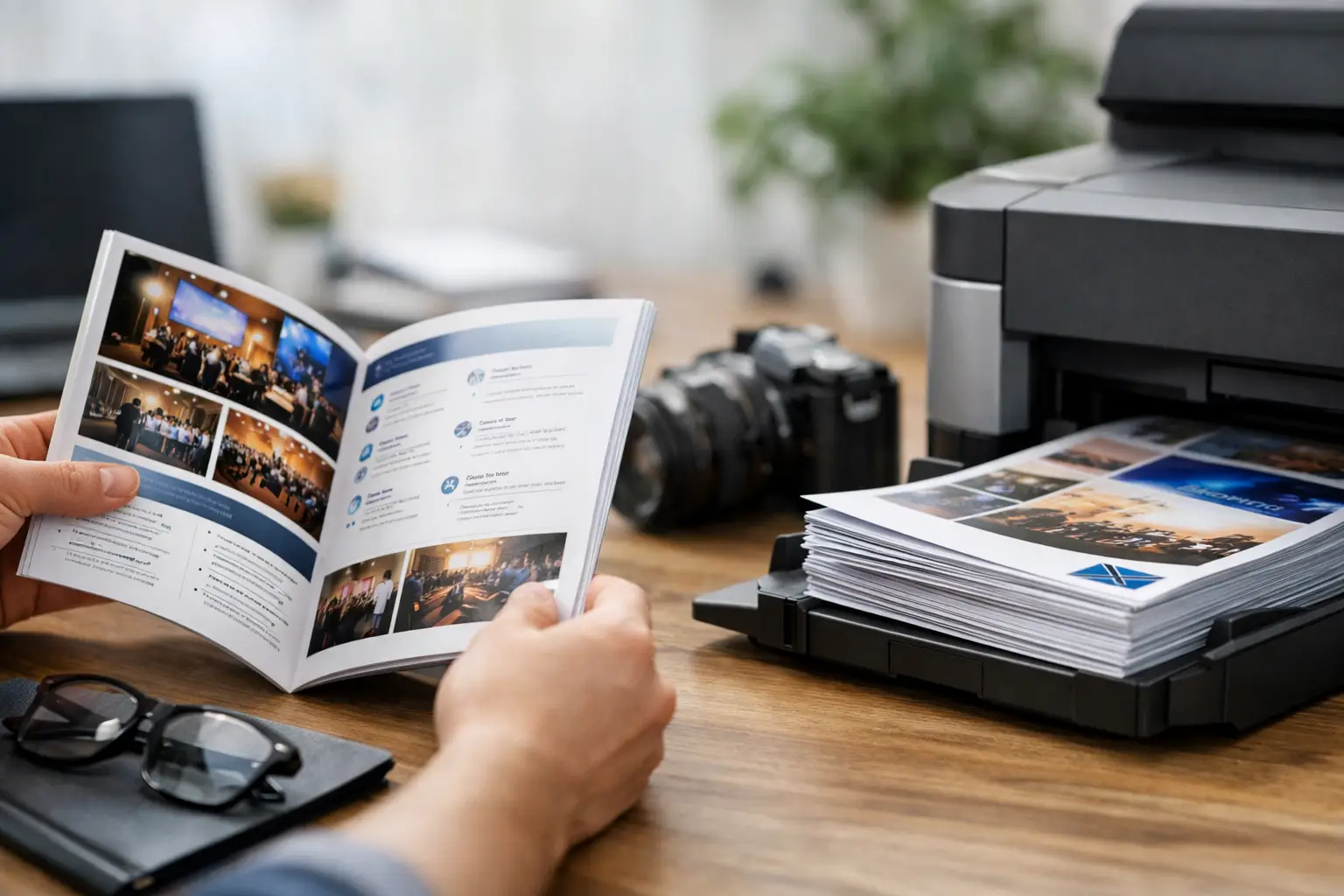
A program is often the first useful item a guest picks up at an event. It tells them where to go, what is happening next, who is being recognized, and which sponsors helped make the day possible. This guide to event program printing will help you make those details easy to find and present them in a format that reflects the care behind your event.
For a school performance, fundraiser, conference, tournament, gala, or community celebration, the right program balances practical information with a professional finish. The goal is not simply to fill pages. It is to give attendees a clear, dependable guide they can use from the opening welcome through the final thank-you.
Start With the Event Experience
Before choosing paper or page count, consider how people will use the program. A seated theater audience may appreciate a folded program that fits neatly in a lap or purse. A conference attendee may need a multi-page booklet with session times, room locations, speaker biographies, and sponsor information. A tournament program might need schedules, team rosters, maps, and space for notes.
Think about the setting, the expected length of the event, and how often guests will refer to the piece. Programs for brief ceremonies can be concise and elegant. All-day or multi-day events usually require more detailed navigation. If the schedule is likely to change, build enough flexibility into the layout so a revision does not mean redesigning every page.
A printed program should support the event, not compete with it. Large blocks of copy, tiny type, and crowded schedules make a program harder to use when guests need information quickly.
Choose a Format That Fits the Content
The format affects both usability and cost. A simple single-sheet program works well for a short agenda, wedding ceremony, awards presentation, or recital. A folded piece adds panels without becoming bulky and is a good choice when you need a cover, inside schedule, acknowledgments, and contact details.
For more substantial content, a saddle-stitched booklet is often the practical choice. It lies relatively flat, accommodates multiple pages, and gives sponsors, advertisers, speakers, or performers room to be featured properly. Page counts for saddle-stitched booklets generally work best in multiples of four because each printed sheet creates four pages once folded.
Common program sizes
Letter size is familiar and provides generous room for schedules and readable type. Half-letter or digest-size booklets are more compact and easier for guests to carry. Square formats can create a distinctive look for galas or arts events, but they may require more careful planning for envelopes, inserts, and storage.
Do not choose a smaller size solely to reduce paper use. If the content becomes cramped, the savings can undermine the program’s purpose. A slightly larger format with fewer pages may be more readable and more cost-effective than a small booklet with excessive page count.
Build a Layout Guests Can Scan
Event programs are reference tools. Readers should be able to find the start time, next session, venue room, or speaker name in seconds. Use clear headings, consistent spacing, and a logical hierarchy throughout the document.
Put the most essential information where guests expect it. The front cover should clearly identify the event, date, and host organization. Early pages should carry the agenda or schedule. Maps, room details, acknowledgments, and sponsor messages can follow, while contact information and future event details often work well near the back.
Keep schedules readable
Schedules are where good program design earns its value. Set times apart from descriptions using bold text, columns, color blocks, or consistent alignment. Leave enough white space between entries so guests can follow the day without losing their place.
Use a readable type size, particularly for audiences that include families, community members, or older attendees. Decorative fonts may suit a headline, but body copy and schedules need clean, familiar typefaces. If your program includes names, titles, or sponsor listings, confirm spelling and capitalization with the people involved before the file reaches production.
Images also deserve careful attention. Use high-resolution photos and logos whenever possible. A low-quality image may look acceptable on a screen but appear soft or pixelated in print. If an image is central to the design, ask for a print proof or discuss the best reproduction approach before committing to the full run.
Select Paper and Finishing With Purpose
Paper gives guests an immediate impression of the event. A standard smooth stock is a practical, economical choice for many programs and schedules. A heavier cover stock can make a folded program or booklet feel more substantial, especially when paired with lighter interior pages.
Gloss paper can make photos and bright graphics stand out, making it useful for entertainment programs, sponsor advertising, and image-heavy event materials. Matte or uncoated paper has a more understated appearance and is easier to write on. That can be useful for conference programs, tournament booklets, workshops, or events where guests may take notes.
Finishing choices should serve the piece. Folding keeps a short program organized. Saddle stitching is efficient for booklets with moderate page counts. A thicker, more durable cover can be worthwhile for a program intended to become a keepsake. On the other hand, extra finishing may not add value for a one-hour event with a simple agenda.
Set Quantity and Timing Early
A common mistake is ordering exactly the number of registered attendees. Programs are also needed by organizers, presenters, volunteers, sponsors, venue staff, and late registrants. A modest overage provides breathing room and is usually less stressful than running short at the door.
Your quantity decision should account for whether programs will be handed out to every attendee, placed at seats, included in registration packages, or made available at a table. If the event is recurring, consider retaining a few copies for records, future promotion, or sponsor follow-up.
Timing matters just as much. Programs often depend on information from several people: a final agenda, speaker bios, advertiser artwork, logos, award recipients, and approvals from event leadership. Those moving pieces can create last-minute pressure, so set internal deadlines before the print deadline.
A reliable planning sequence is to finalize the format and page count first, collect content against a firm cutoff, review the complete proof carefully, then release the file for production. Avoid making major content changes after approving a proof. Even a small revision can shift text, alter page flow, or create unexpected changes elsewhere in the booklet.
Prepare Files for Accurate Printing
Professional-looking results begin with production-ready files. Supply final artwork at the correct finished size, with sufficient image resolution and any needed bleed around elements that extend to the edge of the page. Bleed gives the printer room to trim the piece cleanly without leaving unwanted white edges.
Keep important text, logos, and page numbers inside a safe margin. This is especially important for folded programs and saddle-stitched booklets, where content too close to a fold or trim edge may be difficult to read. For booklets, confirm that page numbers, cover placement, and inside spreads are in the right order.
Color is another area where expectations should be clear. Brand colors, sponsor logos, and key visual elements should be reviewed with print output in mind. Screens are illuminated and can display colors differently from ink on paper. A proof is the best opportunity to check color balance, image quality, content accuracy, and overall readability before the full quantity is produced.
For Kamloops-area organizations managing an event with multiple printed pieces, working with one experienced print partner can simplify the process. Noran Printing can help coordinate programs alongside posters, tickets, table signage, name badges, promotional materials, and branded apparel so the event presents a consistent, professional look.
Give the Final Proof a Real Review
Do not treat proofing as a quick glance. Read the program as an attendee would. Check the event date, venue address, start times, room names, sponsor logos, names of honorees, contact details, and page order. Then have a second person review it with fresh eyes.
Pay special attention to details that can affect the event in real time: a missing session, an incorrect room number, a sponsor omitted from an acknowledgment page, or a QR code that does not scan. Print a desktop copy if possible. Physical review often reveals crowded areas, weak contrast, and text that looked larger on screen.
A well-printed event program does more than list the schedule. It helps guests feel informed, recognizes the people who made the event possible, and leaves behind a tangible reflection of your organization. Plan it with the same care you bring to the event itself, and it will do its job quietly and well from the first arrival to the final applause.