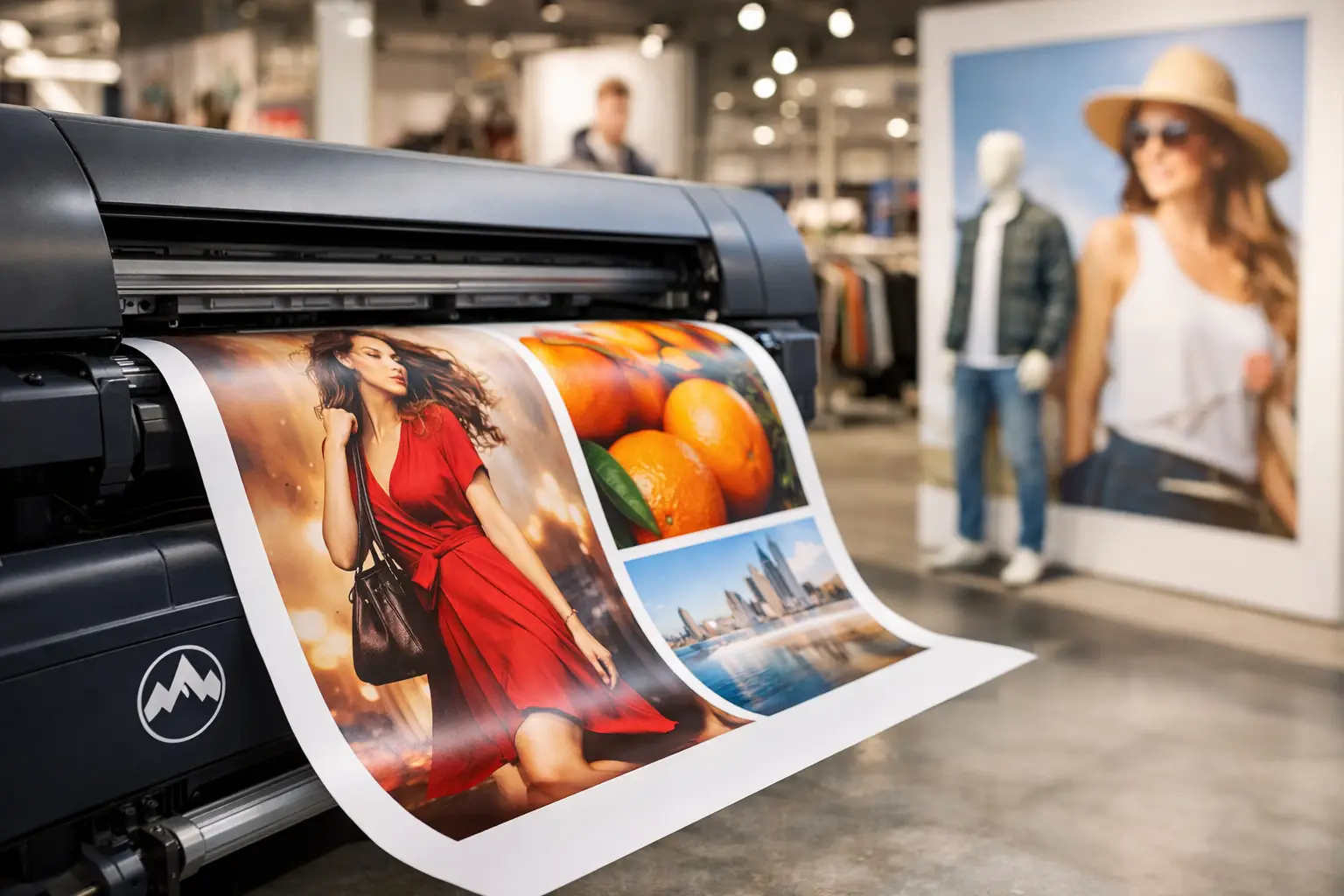
A faded window banner and a cluttered aisle sign can make even a well-run store look tired. On the other hand, sharp, well-placed graphics can stop foot traffic, direct customers, and reinforce the quality of what you sell. That is why large format printing for retail is not just about making signs bigger. It is about making your store easier to shop and harder to ignore.
Retail environments move fast. Promotions change, seasons shift, inventory turns over, and customer attention is limited. Large-format pieces such as posters, window graphics, point-of-purchase displays, aisle markers, and promotional boards help bridge that gap between what you want to say and what a customer actually notices in the moment.
Why large format printing for retail works
Retail signage does two jobs at once. First, it gets attention. Second, it gives customers enough information to take the next step, whether that means entering the store, heading to a featured section, or making a purchase decision.
Size matters, but placement and clarity matter just as much. A large poster with weak contrast or too much text will still be ignored. A smaller sign in the right spot with a clear message can outperform it. The strongest retail printing is built around real customer behavior. People scan quickly. They react to bold visuals, short messages, consistent branding, and pricing or promotional cues that are easy to process at a glance.
This is where large format print becomes practical, not decorative. It can help define zones in a store, support seasonal campaigns, launch products, and create consistency across multiple printed materials. When done well, it also reduces confusion. Customers should not have to guess where to go, what is on sale, or what makes one product different from another.
The retail spaces where large format print matters most
Window space is often your first and best chance to make an impression. Window graphics and posters can promote limited-time offers, highlight new arrivals, or simply signal that your business is active and current. If the front of the store looks neglected, people notice. If it looks updated and intentional, they notice that too.
Inside the store, large-format signage helps shape the shopping experience. Hanging signs, wall graphics, and end-cap displays help customers navigate without asking for help. That can improve flow, especially in stores with multiple departments, frequent promotions, or high foot traffic.
Checkout areas are another overlooked opportunity. Smaller retail graphics often handle impulse messaging, but large-format print can support loyalty programs, cross-sell offers, gift card promotions, or event announcements in a way that stays visible while customers wait.
For pop-up shops, trade counters, showrooms, and temporary retail setups, large-format materials are often what make the space feel established. A branded backdrop, retractable banner, mounted board, or floor graphic can quickly turn an empty footprint into a professional retail environment.
Choosing the right format for the job
Not every retail message belongs on the same material. This is where many businesses waste budget. They pick a format based on price alone, then use it in a location where it does not hold up or does not perform.
Window graphics work well for outward-facing promotions, but they need to account for visibility, lighting, and installation surface. Posters are cost-effective for frequent campaign changes, especially if you run regular specials. Mounted signs offer a more durable, polished option for longer-term messaging such as category branding or store policies.
Floor graphics can be useful in high-traffic areas, but only when the design is simple and the surface is appropriate. Banners are versatile and easy to move, which makes them a good fit for events, temporary promotions, or multi-use spaces. Backlit displays can add impact in some retail settings, although they are not necessary for every store and may be more than a smaller business needs.
The right choice depends on how long the sign needs to last, where it will be displayed, how often the message changes, and how your customers move through the space. A dependable print partner should help you sort through those trade-offs instead of pushing a one-size-fits-all option.
Design decisions that affect results
Retail signage needs to be readable before it is impressive. If a customer has to stop and decipher the message, the sign is doing too much. Strong retail print usually relies on a short headline, one clear callout, and brand elements that support the message without crowding it.
Color accuracy matters more than some businesses expect. A washed-out sale sign or inconsistent brand colors can make a campaign look less professional than intended. Typography matters too. Thin fonts, oversized paragraphs, and low-contrast layouts often fail in real store conditions, especially from a distance.
Image quality is another common issue. Large-format printing enlarges everything, including flaws. Files that look acceptable on a screen or in a small proof can fall apart when scaled up. That is why production guidance matters. Good output starts with proper file setup, suitable resolution, and a design that fits the viewing distance.
Durability is part of the value
A sign that curls, fades, tears, or peels too early is not a bargain. Retail environments can be tough on print. Sunlight, temperature changes, repeated handling, and heavy traffic all affect performance.
That does not mean every sign needs premium materials. It means the material should match the use. A short-term promotional poster and a semi-permanent wall graphic serve different purposes and should be produced accordingly. Spending a bit more on the right stock or finish can save money if it prevents reprints and keeps the store looking sharp longer.
Large format printing for retail and seasonal change
Most retailers do not need static signage all year. They need a system that can adapt. Seasonal campaigns, holiday messaging, clearance events, and local promotions all benefit from print pieces that are easy to update without rebuilding the entire visual setup.
This is where planning ahead pays off. If your spring sale, back-to-school campaign, and holiday push happen every year, it makes sense to think in terms of reusable display structures and replaceable graphics. That approach can reduce waste, speed up turnarounds, and keep branding consistent across different campaigns.
For businesses with more than one promotional window during the year, scheduling print production early also helps avoid rushed decisions. Last-minute signage often leads to design shortcuts, missed opportunities, and materials that are chosen for convenience rather than fit.
What local retailers should expect from a print partner
Retail printing is rarely a one-time order. Even a simple promotion can involve window pieces, interior signs, counter materials, and supporting printed items. Working with one provider who can manage those pieces together tends to create better consistency and fewer delays.
That matters even more when timing is tight. A local business preparing for an event, a sale, or a store refresh often needs practical advice as much as production. File review, material recommendations, quantity planning, and realistic timelines all make a difference. For businesses in Kamloops and surrounding communities, that kind of hands-on service can save time and prevent expensive rework.
A full-service shop also helps when your retail signage needs to align with brochures, menus, flyers, labels, or other branded materials. Customers notice when messaging and visual standards are consistent across every touchpoint. It signals that the business is organized, active, and reliable.
When bigger is not better
There is a tendency to assume that large format always means maximum impact. Sometimes it does. Sometimes it just means more surface area for a weak message.
If your store already has too many competing visuals, adding more large signs can make things worse. Retail graphics should create hierarchy, not noise. One strong campaign message at the entrance and a few supporting signs inside usually work better than trying to say everything at once.
It also depends on the kind of retail environment you operate. A boutique may benefit from restrained, polished signage that supports a premium feel. A discount retailer may lean into bold pricing and volume messaging. Neither approach is automatically right. The best solution fits the customer, the merchandise, and the pace of the space.
Well-executed retail print does not have to shout. It has to work. When signage is clear, well-produced, and matched to the store, it supports sales without getting in the way. That is the standard worth aiming for if you want your print to do more than fill empty wall space.