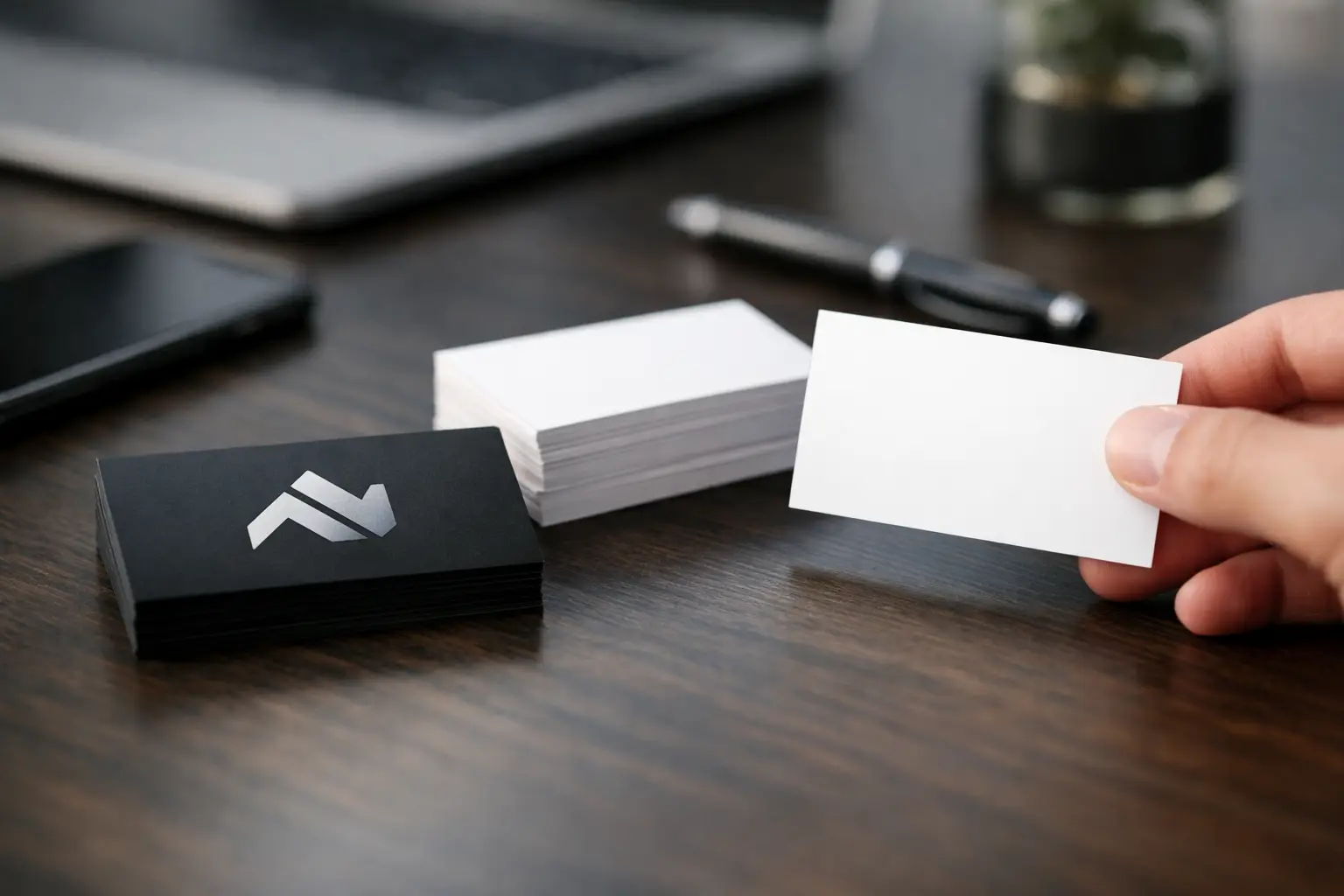
A quick handshake at a trade show, a meeting with a new supplier, a conversation after a local event – these moments move fast. The purpose of business cards is to make sure your contact details, your brand, and your first impression do not disappear when the conversation ends. A good business card gives someone a practical reason to remember you and an easy way to reach you later.
That may sound simple, but it is exactly why business cards still matter. Even with phones, email, and social platforms doing most of the follow-up work, a physical card does something digital contact sharing often does not. It creates a pause. It gives the other person something tangible. It signals that you came prepared, that your business is established, and that you take presentation seriously.
The real purpose of business cards
At the most basic level, a business card shares contact information. Name, company, phone number, email, website, and role are still the essentials. But if that were the only job, a phone note or text message would replace the card completely. The real value is broader.
A business card acts as a compact brand piece. In one small format, it communicates your visual identity, your professionalism, and sometimes even your market position. The paper stock, print quality, layout, and finish all send signals before a person ever calls or emails you. A flimsy, hard-to-read card can weaken trust. A clear, well-produced card can quietly reinforce confidence.
It also supports memory. People meet dozens of contacts in a month, sometimes in a week. If your card is readable, well designed, and tied clearly to what you do, it helps the recipient connect your name with a service or product later. That is often the difference between being remembered and being forgotten.
Why the purpose of business cards goes beyond contact details
For many businesses, the card is not just an introduction. It is a sales support tool. It gives your team a simple, consistent way to represent the company in meetings, site visits, networking events, conferences, retail interactions, and community functions.
This matters especially for small and midsize organizations. Not every customer journey starts with a polished pitch deck or a full proposal. Sometimes it starts with a short conversation and a card that looks credible. In service businesses, that can be enough to move the next step forward.
There is also a practical advantage. Business cards work without batteries, signal, passwords, or platform preferences. They are quick to hand over and easy to keep. Not every prospect wants to scan a code in the middle of a conversation. Not every setting makes phone-based contact sharing feel natural. A card remains one of the lowest-friction ways to exchange information.
Business cards still matter in a digital-first market
Some business owners assume cards are outdated because so much communication happens online. That is understandable, but it misses how business actually gets done. Many relationships still begin face to face, and those first exchanges often shape whether someone follows up.
A digital connection is useful, but it is also easy to lose. Contacts get buried. Messages are forgotten. New names blend together in crowded inboxes. A printed card creates a physical reminder that can sit on a desk, go into a wallet, or stay in a file until the timing is right.
This does not mean every card will produce results. The card has to be relevant and usable. If it is overloaded with information, poorly printed, or inconsistent with your brand, it may not help much. But when it is designed with care and printed properly, it can hold its value far longer than many people expect.
What a business card says about your company
Every printed piece reflects on your business, and business cards are no exception. Because they are small, people often underestimate how much detail matters. In reality, cards are one of the fastest ways a customer forms an opinion about your standards.
A clean layout tells people you are organized. Sharp print tells them you pay attention to quality. Consistent logos, fonts, and brand colors suggest stability. Those details are especially important for companies that depend on trust, repeat business, or referrals.
There is a trade-off, though. A business card does not need to be flashy to be effective. In many industries, clarity matters more than novelty. A contractor, accountant, school administrator, nonprofit coordinator, or local retailer usually benefits more from a card that is professional and readable than one trying too hard to stand out. The right design depends on your audience and how you use the card.
When business cards deliver the most value
Cards are most effective when they support real interactions. Networking events are the obvious example, but they are far from the only one. Business cards work well during sales calls, consultations, front desk conversations, deliveries, community sponsorships, fundraising events, and informal introductions.
They also help inside organizations. Staff members who meet vendors, donors, parents, partners, or the public need a simple way to represent the business consistently. A shared card format across departments or team members supports a more polished image and avoids the patchwork look that can happen when materials are ordered inconsistently.
For some businesses, cards can do double duty. Appointment reminders, loyalty details, service categories, or a short call to action can make the card more useful. That said, there is a limit. If you try to turn a card into a brochure, it usually becomes harder to read and less effective. The best cards stay focused.
How to make the purpose of business cards work for you
If you want business cards to do their job, start with function. The contact details should be easy to read at a glance. Font size, spacing, and contrast matter more than decorative choices. People should not have to search for your phone number or wonder what your company actually does.
Next, think about brand consistency. Your card should match the rest of your printed materials and customer-facing assets. If your card looks unrelated to your signage, brochure, letterhead, or presentation folder, it can weaken recognition. Consistency builds familiarity, and familiarity supports trust.
Material choice matters too. Standard cards work well for many organizations, but heavier stock or specific finishes may be worth considering if they fit your brand. The goal is not extravagance. It is durability and professionalism. A card that feels solid in hand tends to be kept longer and taken more seriously.
Print quality is the final piece that often gets overlooked. Color accuracy, crisp text, and clean cutting all affect the impression your card makes. That is one reason many businesses prefer working with an experienced local print partner rather than treating cards like a throwaway item. When your card represents your business in the field, quality control matters.
Common mistakes that weaken a business card
One of the biggest mistakes is including too much information. A card is not meant to explain everything about your company. It should identify you clearly and make follow-up easy. Trying to add every service, social account, slogan, and message usually creates clutter.
Another mistake is poor readability. Light text on light backgrounds, tiny fonts, crowded layouts, and overdesigned graphics can all make a card less effective. If the recipient cannot read it quickly, the opportunity may be lost.
Inconsistent ordering is another problem for growing teams. When different employees use different logos, colors, titles, or formats, the brand starts to look fragmented. A standardized approach saves time and protects your image.
Finally, some businesses order cards once and forget about them for years. Outdated phone numbers, old job titles, and expired branding create confusion. A business card only works when the information is current.
A small printed piece with a clear job
The purpose of business cards is not to replace your website, your email, or your digital marketing. It is to support real-world business by making personal connections easier to remember and easier to act on. That role is still valuable, especially for organizations that want to present themselves with consistency and confidence.
When a card is well designed, accurately printed, and aligned with your brand, it becomes more than a formality. It becomes a practical tool that supports credibility, recognition, and follow-up. For many businesses, that small piece of print still earns its place every day.
If you hand someone your card, it should feel like an extension of your business – clear, dependable, and ready to make the next conversation easier.