
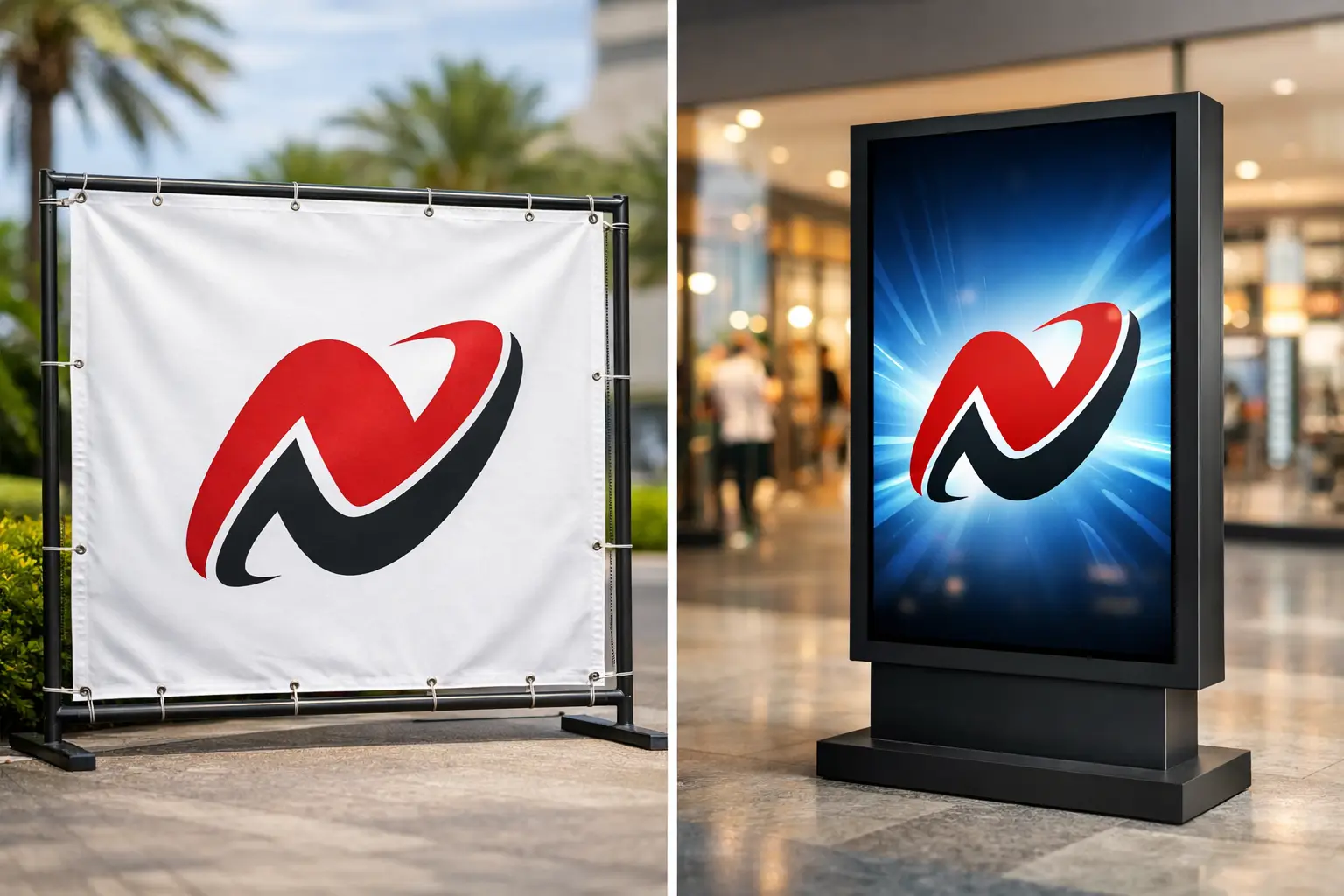
A storefront promotion that needs to last six months has different demands than a lunch special that changes every afternoon. That is the practical question behind vinyl banners vs digital signage: not which format is newer or more eye-catching, but which one will do the job reliably for your message, audience, location, and budget.
For many local businesses, schools, event organizers, and community groups, the strongest choice is not always one or the other. A banner can provide durable, always-on visibility outside, while a digital display keeps indoor announcements current. The right decision starts with understanding where each format delivers real value.
Vinyl Banners vs Digital Signage: The Core Difference
Vinyl banners are printed graphics on durable vinyl material. They are a fixed-message sign designed for visibility, portability, and straightforward installation. A banner can announce a grand opening, sponsor a tournament, direct visitors at an event, promote a sale, or display a building message for weeks or months at a time.
Digital signage uses an electronic screen to show changing content such as images, slides, video, menus, announcements, schedules, and promotions. Its main advantage is flexibility. One screen can show several messages throughout the day, with content updated as business needs change.
The trade-off is simple. Vinyl is typically more affordable upfront and requires no power, software, or ongoing content management. Digital signage costs more to purchase and operate, but it can reduce the need to reprint materials when information changes frequently.
When Vinyl Banners Make the Most Sense
Vinyl banners are a practical choice when the message is stable, the display needs to work outdoors, or the budget needs to stay focused on a single campaign. They are familiar, durable, and easy for customers to understand at a glance.
A contractor promoting services at a job site, for example, does not need a screen that changes every hour. A professionally printed banner with a clear logo, phone number, and service message can work continuously without technical setup. The same applies to school fundraisers, seasonal community events, parking directions, sponsorship displays, and temporary storefront promotions.
Best for outdoor visibility
Outdoor conditions matter. Wind, sunlight, rain, and changing temperatures can be hard on signs. Properly produced vinyl banners are built for these environments, and finishing options such as reinforced hems and grommets help support secure installation.
A digital screen can be used outdoors, but it must be designed and installed for outdoor exposure. That means weather-rated equipment, appropriate brightness, electrical access, mounting hardware, and protection against damage or tampering. For a short-term outdoor promotion, a banner is usually the more efficient option.
Best for a fixed message
A banner works especially well when the information will not change before the campaign ends. Think of a message such as “Now Open,” “Welcome Tournament Guests,” “For Lease,” or “Annual Food Drive.” In these cases, the printed format is not a limitation. It is a strength because it keeps the message visible without another task for your team.
Good banner design is direct. Use a strong headline, limited copy, clear branding, and a call to action that can be read from the expected viewing distance. Trying to fit a brochure’s worth of information onto a banner weakens its impact.
Best for simple logistics
A banner can be rolled, transported, stored, and installed in many locations. It does not rely on Wi-Fi, an app, a remote player, or an employee remembering to update content. For organizations managing volunteers, busy event schedules, or multiple locations, that simplicity can be valuable.
It also makes banners useful as a supporting piece of a larger campaign. A business may use printed banners outside, posters at entry points, flyers for take-home information, and window graphics to reinforce the same promotion.
When Digital Signage Is Worth the Investment
Digital signage earns its place when a message must change often, when multiple messages need to share the same space, or when movement and timely information improve the customer experience. It is particularly effective inside businesses, waiting areas, reception spaces, schools, restaurants, and facilities where people spend enough time to notice changing content.
A restaurant is a clear example. Printed menu boards can look excellent, but repeated price updates, daily specials, and limited-time offers can make reprinting costly over time. A digital menu system lets staff update the day’s features without replacing the entire display.
Best for changing information
If your content changes weekly, daily, or several times a day, digital signage can save time and reduce waste. A fitness center may rotate class schedules and promotions. A clinic can share check-in instructions, service reminders, and seasonal health messages. A school can post announcements, event dates, and emergency notices from one central display.
That flexibility only helps if someone owns the updates. A screen showing outdated promotions, incorrect hours, or last month’s event does not communicate professionalism. Before investing, decide who will create content, approve it, schedule it, and check that the screen is working.
Best for several messages in one location
Digital displays can cycle through content, allowing one installation to serve several departments or campaigns. This is useful when physical wall space is limited. Instead of covering a lobby with multiple posters, a business can display a short sequence of branded messages.
There is a limit, however. Just because a screen can show ten messages does not mean viewers will absorb ten messages. Keep each slide focused, readable, and on screen long enough to be understood. Movement should support the message, not compete with it.
Best where presentation supports the experience
A well-managed screen can make an interior feel current and organized. It can reinforce branding through consistent colors, typography, and imagery while giving customers useful information. In a showroom, it can highlight featured products. At a reception desk, it can answer common questions before staff need to do so.
This benefit is strongest where the display is part of a broader customer experience. A screen mounted in a low-traffic corner with no clear purpose is unlikely to justify its cost.
Compare the Cost Beyond the First Purchase
The initial price is often where businesses begin, but it should not be where they stop. Vinyl banners generally have a lower upfront cost. Once printed, they need only installation and occasional cleaning or replacement if they become worn or the message is no longer relevant.
Digital signage involves equipment, mounting, power, content software or media players in some setups, installation, and ongoing management. Screens also have a lifespan and may require repairs or replacement. For a single short-term message, that investment is difficult to justify.
Over time, the math can change. If you reprint posters, banners, or menu boards every few weeks because information changes constantly, a digital display may become more economical. The deciding factor is frequency. Calculate how often you replace printed materials, not just how much the first print run costs.
Consider Viewing Distance, Location, and Attention
The best sign is one people can read under real conditions. A banner near a road needs large type, strong contrast, and a concise message. A lobby display can carry more information because viewers have time to pause. A digital screen behind a busy counter may need to prioritize a few large, high-value messages rather than fast-moving graphics.
Location also affects durability and installation. Ask whether the sign will be exposed to weather, whether power is available, how it will be mounted, and whether staff can reach it safely for updates or maintenance. These details influence the right format as much as the design itself.
For multi-location organizations, consistency matters. A coordinated set of printed materials may be easier to deploy across several sites, while centrally managed digital screens can help keep changing information aligned. Neither approach is automatically better. It depends on how your organization operates.
A Combined Approach Often Delivers Better Results
Many effective campaigns use both formats because they perform different jobs. A vinyl banner can catch attention outdoors and direct people inside. Digital signage can then share current offers, event details, product information, or next steps once visitors are on site.
For an event, printed banners can identify entrances, parking, sponsors, and activity areas. Indoor screens can display schedules, live updates, and acknowledgments that change throughout the day. This approach avoids asking one sign format to do everything.
At Noran Printing, the goal is to help businesses choose materials that work in the real world, not simply fill a space. A clear understanding of your message, timeline, setting, and update schedule makes the production decision much easier.
Before ordering, write down the one action you want people to take after seeing the sign. If that action depends on a message that will stay the same, print it with confidence. If it depends on information that changes constantly, build a process to keep a digital display current.