The busiest booth on the floor is not always the one with the biggest budget. More often, it is the one that can be understood in three seconds. That is where a good guide to trade show signage matters. Your signs have one job before any salesperson starts a conversation – stop people, tell them who you are, and make the next step obvious.
At trade shows, people move quickly and make snap decisions. They scan from the aisle, glance over shoulder height, and keep walking if the message is unclear. Strong signage works because it respects that reality. It does not try to say everything. It prioritizes visibility, hierarchy, and consistency so your booth feels professional from a distance and informative up close.
What a guide to trade show signage should help you decide
Most businesses do not struggle because they forgot to order a banner. They struggle because they ordered pieces without a system. A backdrop says one thing, a table throw says another, and the handouts use a different logo or color. Even when each item looks fine on its own, the booth can still feel disconnected.
A practical signage plan starts by answering three questions. What do you want attendees to notice first? What do they need to understand next? What action should they take after that? When those answers are clear, the design and print choices become much easier.
For some exhibitors, the first priority is brand recognition. For others, it is a product launch, a service category, or a simple invitation to book a consultation. There is no single right formula. A construction company, school, nonprofit, and medical practice will each need different signage because their audiences make decisions in different ways.
Start with the viewing distance
Trade show signage fails most often when the content is designed for the wrong distance. A backdrop viewed from 20 feet away should not carry the same amount of information as a tabletop sign viewed from 2 feet away. If every surface is filled with body copy, nothing stands out.
Your largest sign should carry only the most important message. Usually that means your business name, a short value statement, and a clear visual that supports the offer. Smaller signs can handle supporting details such as product features, service options, pricing, or event-specific promotions.
This is one of the most useful rules in any guide to trade show signage – match the message length to the distance. Keep overhead or rear-wall graphics simple and bold. Save the finer points for counter cards, brochure holders, or posters positioned where someone can stop and read.
The core signage pieces most booths need
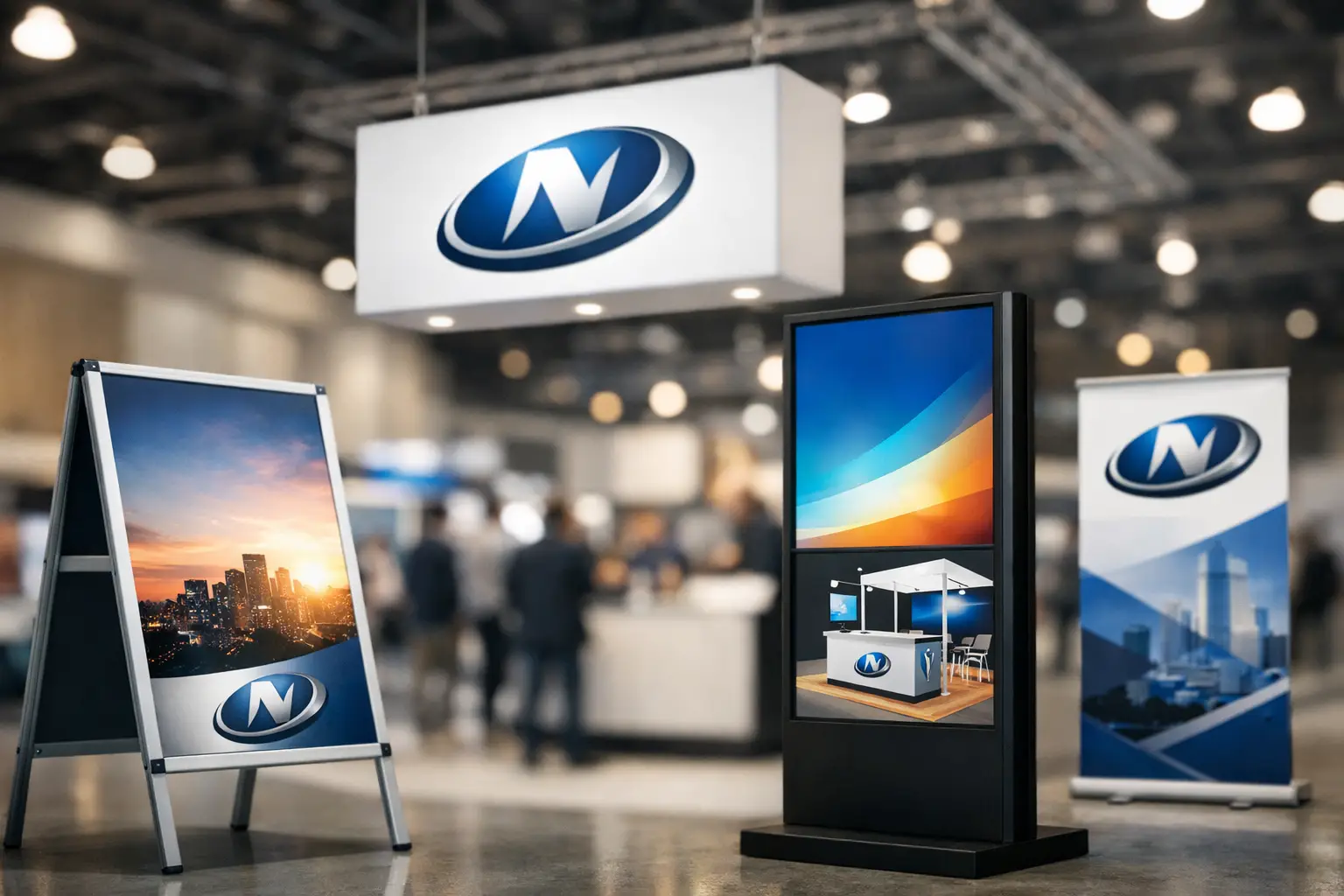
Not every event calls for a full custom display, but most successful booths use a combination of large-format branding and smaller supporting pieces. A backdrop or banner wall usually acts as the anchor. It gives your space structure, sets the visual tone, and helps attendees identify your booth from across the aisle.
Retractable banners are often a smart choice for businesses that attend multiple events. They travel well, set up quickly, and can be reused in offices, lobbies, or community functions. Table throws matter more than many exhibitors expect because the front of the table is often one of the first surfaces people see. A clean, branded table cover makes the space look organized even before visitors engage.
Posters, mounted boards, counter signs, and product cards help tell the rest of the story. If you have multiple services, separate signs can work better than one crowded panel. That way, attendees can quickly spot the category that applies to them. If you are demonstrating equipment or showcasing samples, signs placed at the point of interest can answer common questions without requiring staff to repeat the same explanation all day.
Message hierarchy matters more than clever wording
Trade show signage is not brochure copy enlarged to poster size. It needs to work in seconds. That means a strong headline, a short supporting phrase, and a layout that directs the eye naturally.
The best booth messaging is usually plainspoken. Say what you do. Say who it is for. Say why it matters. Clever taglines can help if your brand already has recognition, but for many small and mid-sized businesses, clarity outperforms creativity.
A good headline might identify a service category, a key result, or a problem you solve. The secondary line can add context. Then your call to action should give visitors a reason to stop, ask, scan, sample, or schedule. If every sign is trying to be the headline, the booth becomes visually noisy and people move on.
Design choices that improve readability
High contrast is your friend. Light gray text on a white background may look refined on a monitor, but it can disappear under event lighting. Strong contrast, clean typefaces, and generous spacing make signage easier to read from a distance and at an angle.
Image quality matters just as much. A low-resolution photo that looks acceptable on a laptop screen can print poorly at large format. Logos should be supplied in proper high-resolution or vector files whenever possible. This is one reason working with an experienced print partner helps – production quality is not only about the printer, but also about catching file issues before they become expensive booth problems.
Size and material also depend on how often you exhibit. If a display will be used several times a year, durability matters. If it is for a single event, you may have more flexibility to balance cost and lifespan. Foam boards, mounted posters, fabric backdrops, vinyl banners, and retractable systems each have their place. The best option depends on transport, setup conditions, and how polished the presentation needs to look.
Common trade show signage mistakes
The most common mistake is saying too much. Businesses often feel pressure to justify the booth investment by listing every service, every feature, and every credential. The result is a wall of text that no one reads. It is better to focus on the top message and let staff, handouts, or follow-up materials carry the detail.
Another problem is inconsistency. Mismatched colors, outdated logos, or signs created at different times by different vendors can make a business look less established than it really is. Consistent branding does not mean everything must look identical, but it should all feel related.
Timing is another issue. Trade show printing often involves more than one piece, and last-minute orders limit your options. Proofing, finishing, and correcting files all take time. Rushing increases the chance of errors in sizing, text, and color. For events with fixed setup dates, dependable turnaround is part of the signage strategy, not an afterthought.
How to plan signage for your specific event
Before ordering anything, think about the event environment. A local business expo, a school showcase, and an industry conference each create different expectations. In a crowded hall, bold identification may be the priority. In a more relationship-driven setting, educational signage and handout coordination may matter more.
Booth size changes the plan as well. A small tabletop display needs discipline. You cannot fit every message, so choose one core promise and support it with one or two secondary visuals. A larger booth gives you more room, but it also creates more surfaces to manage. More space does not automatically mean more copy. It means more opportunity to guide movement and reinforce your message.
It also helps to think beyond the booth itself. If you are handing out brochures, presentation folders, product sheets, or branded promotional items, those pieces should work with the signage rather than compete with it. When print materials and display graphics share the same message and design language, the whole presentation feels more deliberate and more credible.
Why local print support can make the process easier
For businesses preparing for events in Kamloops or surrounding communities, local support can save time and prevent mistakes. Booth graphics often need size checks, proof reviews, reprints, or coordination across multiple items. Working with one print provider for signage, handouts, branded materials, and related event pieces creates a simpler process and better consistency.
That is especially helpful for organizations that do not attend trade shows every month. Most office managers, administrators, and business owners are balancing ten other priorities while preparing for an event. Having a dependable print partner to help with file setup, materials, quantities, and deadlines removes a lot of uncertainty. At Noran Printing, that kind of practical support is part of doing the job properly.
The best trade show signage does not try to impress with complexity. It works because it is readable, well produced, and built around what attendees actually notice. If your booth can clearly answer who you are, what you offer, and why someone should stop, you are already ahead of many exhibitors on the floor. Start there, keep the message focused, and let every printed piece support the same goal.