A branded envelope is often the first printed piece a customer sees. Before they read the letter, invoice, proposal, or invitation inside, they have already formed an impression from the return address, logo, paper, and print quality. Knowing how to choose envelope printing helps your business make that first moment look organized, professional, and consistent with the materials inside.
The right choice is not always the most expensive envelope or the one with the most design elements. It is the option that fits your document, mailing process, budget, and brand standards. Here is what to consider before placing an order.
Start With the Purpose of the Envelope
An envelope for monthly invoices has different requirements than one used for event invitations or sales packages. Start by defining what the envelope needs to do. Will it carry a standard letter? Does it need to hold multiple pages, a booklet, a presentation folder, or a check? Will it be mailed, hand-delivered, or used for internal office correspondence?
For everyday business letters, statements, and invoices, a standard No. 10 envelope is usually the practical choice. It fits a letter-size sheet folded into thirds and works well with most office mailing equipment. If you send larger documents that should not be folded, a 9 x 12 or 10 x 13 catalog envelope may be a better fit. These larger formats are useful for proposals, reports, certificates, and promotional packages.
The purpose also affects how much information belongs on the envelope. A billing envelope may only need a logo and return address. A marketing mailer may benefit from a short message, campaign graphic, or clear callout that gives recipients a reason to open it. Keep the intended use focused so the envelope supports the message rather than competing with it.
Choose the Right Envelope Size and Style
Size is a functional decision, but it also shapes presentation. A small envelope can feel concise and formal. A larger format can create a more substantial, premium impression, especially when it contains sales materials or event information.
Common business envelope options include No. 10 envelopes for regular correspondence, No. 9 envelopes for reply mail, and larger catalog or booklet envelopes for flat documents. Catalog envelopes generally open on the short side, while booklet envelopes open on the long side. Either can work well, but the opening direction may matter if your staff will be inserting materials by hand or using equipment.
Window envelopes are worth considering when you send high volumes of invoices, statements, or form letters. A properly positioned window lets the recipient address printed on the document show through, reducing the need to print or apply separate mailing labels. This can save time and reduce handling errors. The trade-off is that the document inside must be designed precisely so the address aligns with the window every time.
For reply envelopes, consider whether you need a business reply format, a remittance flap, or a space for the sender to write their own return address. These small details can make a process easier for customers and staff alike.
Select Paper That Matches the Job
Most business envelopes are made with smooth white wove paper, and for good reason. It prints clearly, accepts handwriting well, and gives logos and return addresses a clean, professional appearance. For many organizations, it is the dependable everyday choice.
Paper stock becomes more important when the envelope is part of a higher-end package. A heavier, textured, linen, laid, or recycled stock can reinforce the quality of a law firm, real estate office, financial advisor, nonprofit appeal, or formal event. However, specialty papers may cost more, may not run as easily through office printers, and can affect how well labels, stamps, or ink adhere.
Color also deserves careful thought. White is the most versatile choice because it offers strong contrast for addresses and works with nearly any brand palette. Off-white, cream, or light gray can add warmth without making the envelope difficult to read. Dark or highly saturated envelopes can be striking for invitations or hand-delivered materials, but they are often less practical for standard mail. Postal addressing, labels, and barcodes need clear contrast to remain readable.
If sustainability is part of your organization’s purchasing standards, ask about recycled-content options. Recycled paper can support that message, particularly when paired with a simple design that communicates your values without overcrowding the envelope.
Decide What to Print and Where
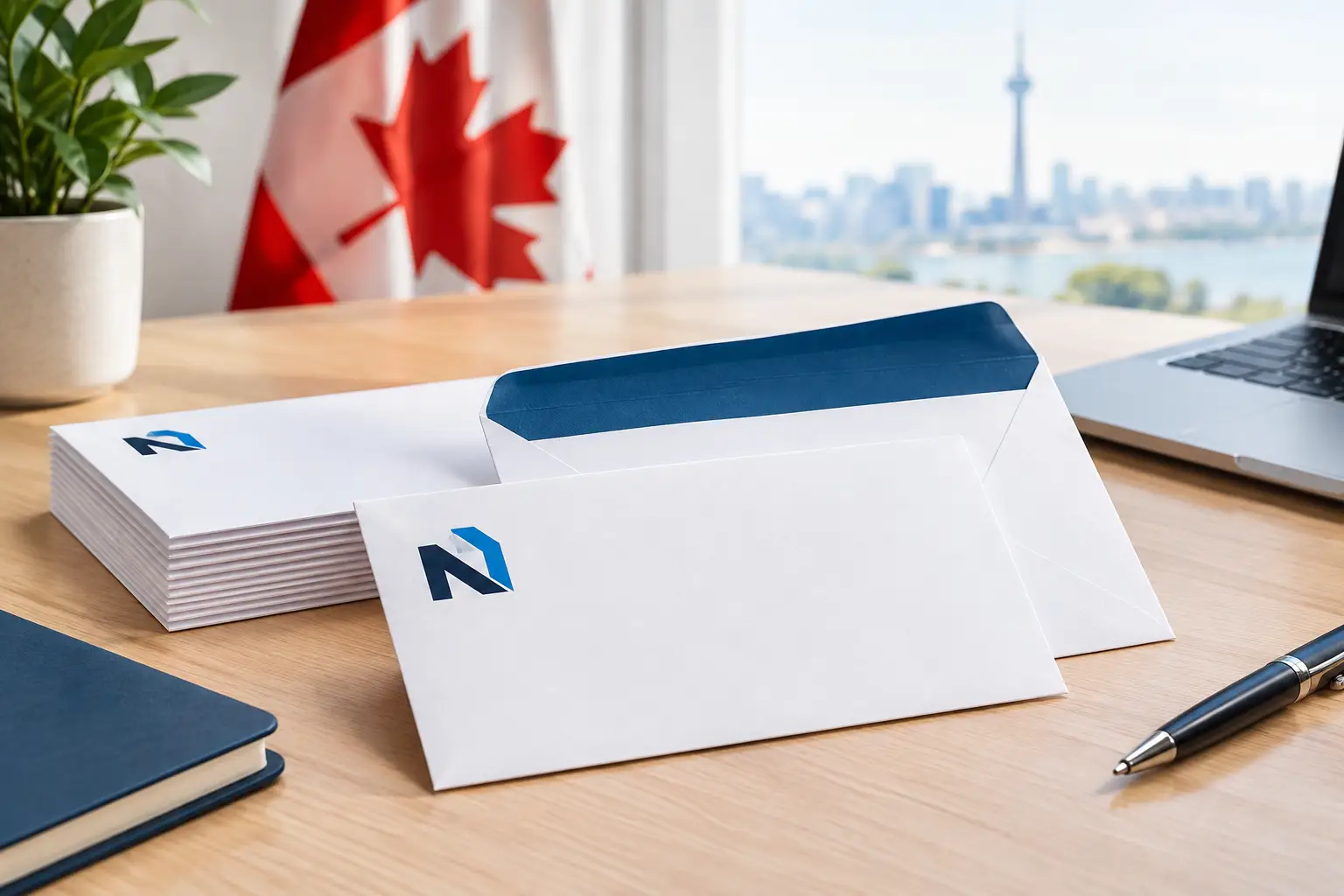
The return address area is valuable real estate. At minimum, it should include your organization name, mailing address, and a reliable way to contact you. Many businesses also add a logo, website, or short service line. The key is balance. An envelope should identify the sender immediately without looking like a flyer.
A common layout places the logo and return address in the upper left corner, leaving the center and lower right areas clear for the recipient address, postage, postal markings, and barcodes. This is familiar to recipients and supports efficient mail processing.
Consider the visual relationship between the envelope and the documents inside. Your business cards, letterhead, invoices, brochures, and envelopes should use compatible logo placement, colors, and typefaces. They do not need to look identical, but they should clearly belong to the same organization. Consistency builds recognition over repeated contact.
If you are adding a promotional message, keep it concise. A line such as “Please open for appointment details” or “Community event information enclosed” can be useful when it accurately reflects the contents. Avoid designs that could be mistaken for postage or that crowd the addressing area.
Choose Between One-Color and Full-Color Printing
One-color envelope printing remains a smart, economical option for many businesses. Black, dark blue, or a single brand color can look polished and professional on a white envelope. It is especially well suited to regular correspondence, accounting documents, and operational mail where consistency matters more than visual impact.
Full-color printing gives you more flexibility for logos with multiple colors, branded graphics, seasonal campaigns, fundraising appeals, and special events. It can make a strong first impression, but it should be used with purpose. A full-color envelope with too much imagery can feel busy, and it may not suit every mailing need.
Also think about the printing method in relation to your quantity and artwork. Digital printing is often efficient for shorter runs, multiple versions, and variable information. It can be a practical solution when different departments, locations, or campaigns need personalized envelopes. Larger repeat orders may call for a production approach that delivers the best unit cost and color consistency over time.
Plan Quantities Around Real Usage
Ordering too few envelopes can lead to rushed reorders and inconsistent stock. Ordering far too many can tie up budget and storage space, particularly if your address, logo, staff information, or branding may change soon.
Review how many envelopes your office uses in an average month, then account for seasonal peaks. Schools may need more for registration periods and fundraising campaigns. Contractors may use more during bidding season. Community organizations may increase mailings before events, membership drives, or year-end appeals.
A useful rule is to order enough for a reasonable production run and a few months of expected use, while avoiding quantities that will become obsolete if your details change. If your needs vary frequently, shorter digital runs may offer more flexibility than placing one very large order.
Check Mailing Requirements Before Approval
Before your envelopes go to print, confirm that the design leaves enough room for recipient addressing, postage, and postal barcodes. This matters most with full-bleed designs, dark backgrounds, oversized logos, and special-format envelopes.
Ask for a proof and review it at actual size. Check spelling, phone numbers, suite numbers, website information, logo clarity, and placement. If you use window envelopes, test the printed letter or invoice inside the sample envelope to verify alignment. A proof is the best time to catch a small error that would be expensive to repeat across thousands of pieces.
It is also wise to consider how the envelope will be addressed. If your office uses an inkjet or laser printer, choose an envelope stock and flap style compatible with that equipment. If you apply labels, make sure there is a clean, open area for them. If the envelope will be handwritten, prioritize a surface that is easy to write on and easy for recipients to read.
Work With a Print Partner Who Asks Practical Questions
Envelope printing is more than placing a logo in the corner. The best result comes from matching the envelope to the document, the mailing method, the volume, and the way your team actually works. A dependable print partner should ask about these details before recommending a stock, size, or print method.
For businesses and organizations managing multiple printed materials, Noran Printing can help keep envelopes aligned with letterhead, forms, business cards, brochures, and other branded pieces. That consistency saves time when ordering and gives every mailing a more professional finish.
A well-chosen envelope does quiet but valuable work for your organization. It protects the contents, supports efficient mailing, and gives every recipient a clear signal that the message inside deserves attention.